HPLC vs LC-MS for Peptide Testing: What Each Method Shows
Learn the difference between HPLC and LC-MS in peptide testing, including how HPLC evaluates purity and how LC-MS helps confirm molecular identity for research-use-only materials.
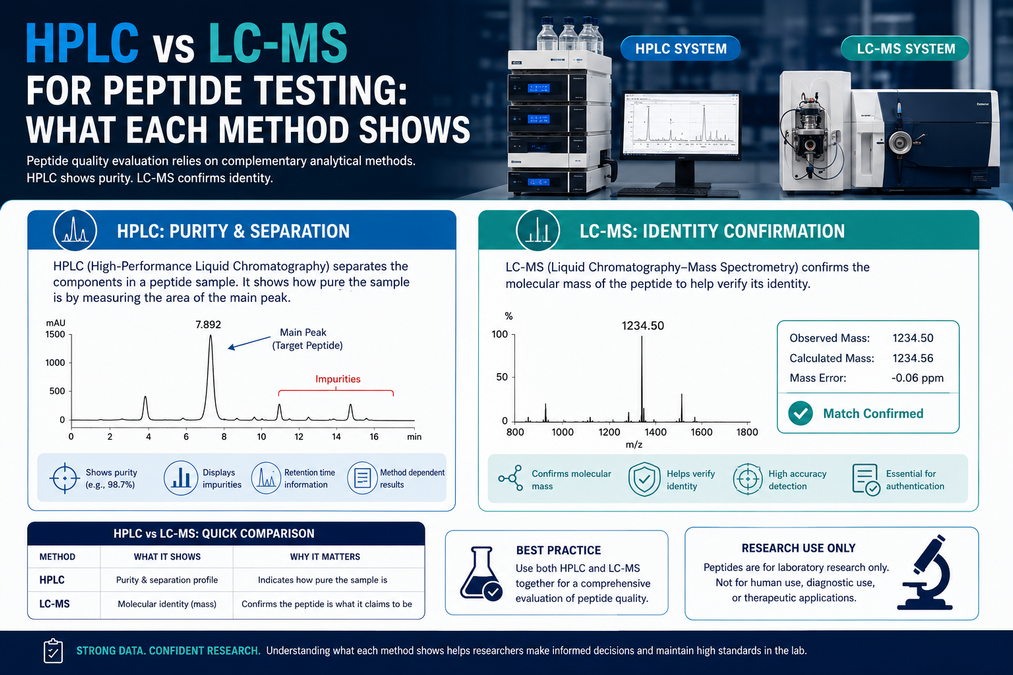
Peptide quality evaluation often involves more than one analytical method. Two of the most common methods used in peptide testing are HPLC and LC-MS.
Although they are sometimes mentioned together, they do not show the same thing. HPLC is commonly used to evaluate purity and separation profile, while LC-MS is commonly used to help confirm molecular identity by comparing the detected mass to the expected peptide mass.
For research-use-only peptide materials, understanding the difference between these methods can help researchers review COAs, batch records, and analytical documentation more clearly.
Research-use-only notice: This article is for informational and laboratory research education only. Peptides referenced here are not intended for persons, clinical use, diagnostic use, treatment, prevention, or guidance.
What is HPLC?
HPLC stands for high-performance liquid chromatography. In peptide testing, HPLC is commonly used to separate the components of a peptide sample and estimate purity based on the relative area of detected peaks.
A peptide sample may contain the target peptide along with smaller amounts of related substances, fragments, synthesis byproducts, or other impurities. HPLC separates these components over time and displays them as peaks on a chromatogram.
The largest peak is usually associated with the main target compound, while smaller peaks may represent impurities or related materials.
What HPLC shows
HPLC helps show the separation profile of the sample.
Common HPLC information may include:
- Main peak area
- Reported purity percentage
- Retention time
- Impurity peaks
- Chromatogram shape
- Method conditions
- Column and solvent information
For example, a COA may list a peptide as 98.7% pure by HPLC. This usually means that the main peak represented 98.7% of the total detected chromatographic area under the stated method.
That number can be useful, but it should always be reviewed together with the chromatogram and method details.
What HPLC does not fully confirm
HPLC is helpful for evaluating purity, but it does not always confirm molecular identity by itself.
A strong main peak may suggest that one component dominates the sample, but HPLC alone does not necessarily prove that the main peak is the expected peptide. That is why identity confirmation is often supported by another method, such as LC-MS.
In simple terms:
- HPLC helps answer: How pure does the sample appear under this method?
- LC-MS helps answer: Does the detected mass match the expected peptide?
Both questions matter when reviewing peptide testing documentation.
What is LC-MS?
LC-MS stands for liquid chromatography-mass spectrometry.
This method combines liquid chromatography separation with mass spectrometry detection. For peptide testing, LC-MS is commonly used to help confirm whether the detected molecular mass matches the expected mass of the peptide.
The mass spectrometry portion measures ions and displays mass-to-charge information. This can help analysts compare the observed mass with the calculated or theoretical mass of the target peptide.
What LC-MS shows
LC-MS helps support identity confirmation.
Common LC-MS information may include:
- Observed mass
- Calculated or theoretical mass
- Mass error
- Mass spectrum
- Identity confirmation notes
- Molecular weight comparison
- Chromatographic separation data
For example, if a peptide has a calculated mass of 1234.56 and the observed mass is 1234.50, the result may support that the detected compound matches the expected peptide within the method’s tolerance.
What LC-MS does not replace
LC-MS is powerful for identity confirmation, but it does not fully replace HPLC purity analysis.
A sample may have an observed mass that matches the expected peptide, but researchers may still need to review purity, impurity peaks, and the separation profile. That is where HPLC is useful.
In many cases, a stronger peptide COA includes both:
- HPLC for purity and chromatographic profile
- LC-MS for molecular identity confirmation
Using both methods provides a more complete view of the tested material.
HPLC vs LC-MS: quick comparison
| Method | What it commonly shows | Why it matters |
|---|---|---|
| HPLC | Purity and separation profile | Helps show the main peak, impurity peaks, and relative purity |
| LC-MS | Molecular identity and mass confirmation | Helps confirm that the detected mass matches the expected peptide |
| HPLC chromatogram | Visual peak separation | Helps support the reported purity percentage |
| LC-MS spectrum | Mass data | Helps support identity confirmation |
| Batch number | Traceability | Connects the analytical result to a specific lot or vial |
Why both methods are useful together
HPLC and LC-MS are complementary.
HPLC can show that a sample has a strong main peak and limited impurity peaks. LC-MS can then help confirm whether the mass of that detected compound matches the expected peptide.
Together, these methods help provide a more complete analytical picture.
A COA that includes both HPLC and LC-MS data is generally more useful than a document that only lists a typed purity percentage without supporting information.
What to look for on a peptide COA
When reviewing a peptide COA, researchers commonly look for both purity and identity information.
A stronger COA may include:
- Product name
- Batch or lot number
- HPLC purity percentage
- HPLC chromatogram
- LC-MS observed mass
- Calculated molecular mass
- Mass error or match notes
- Testing date
- Manufacturing date
- Expiration or retest date
- Laboratory or analyst information
The more complete the documentation, the easier it is to connect the test result to the specific research material.
Common documentation red flags
Some peptide COAs provide limited or incomplete analytical support. Red flags may include:
- No batch number
- No chromatogram
- No LC-MS data
- No observed mass
- Only a typed purity percentage
- Missing testing date
- Missing lab information
- Batch number does not match the vial
- Same COA reused for multiple products or lots
- Blurry, altered, or incomplete documentation
A COA should help clarify quality and identity, not create more uncertainty.
Why batch-specific testing matters
Batch-specific testing connects the analytical data to the material being reviewed.
If a vial label lists a batch number, the COA should list the same batch number. This allows the researcher to connect the product, label, and analytical document together.
Without batch traceability, it is difficult to know whether the COA belongs to the specific vial or lot being reviewed.
Practical way to understand the difference
A simple way to remember the difference is:
HPLC shows purity. LC-MS helps confirm identity.
HPLC focuses on separation and relative peak area. LC-MS focuses on mass detection and whether the observed mass aligns with the expected peptide.
Both methods are valuable, but they answer different questions.
Summary
HPLC and LC-MS are two important analytical methods used in peptide testing.
HPLC is commonly used to evaluate purity and separation profile. It shows the main peak, impurity peaks, retention time, and purity percentage based on chromatographic area.
LC-MS is commonly used to support molecular identity confirmation. It compares the observed mass of the detected compound to the expected peptide mass.
For research-use-only peptide materials, the strongest documentation often includes both HPLC and LC-MS data, along with batch numbers, test dates, and clear traceability.
The most important takeaway is simple:
- HPLC helps show how pure the sample appears.
- LC-MS helps confirm what the sample is.
- Batch numbers connect the data to the specific lot.
- Complete COAs are more useful than unsupported purity claims.
Standards and further reading
Prepared by The Pep Labs Research Editorial Team under the editorial policy.