How to Read a Peptide COA: HPLC, LC-MS, Purity, and Batch Testing Explained
Learn how to read a peptide Certificate of Analysis, including HPLC purity, LC-MS identity confirmation, batch numbers, chromatograms, and common COA red flags for research-use-only materials.
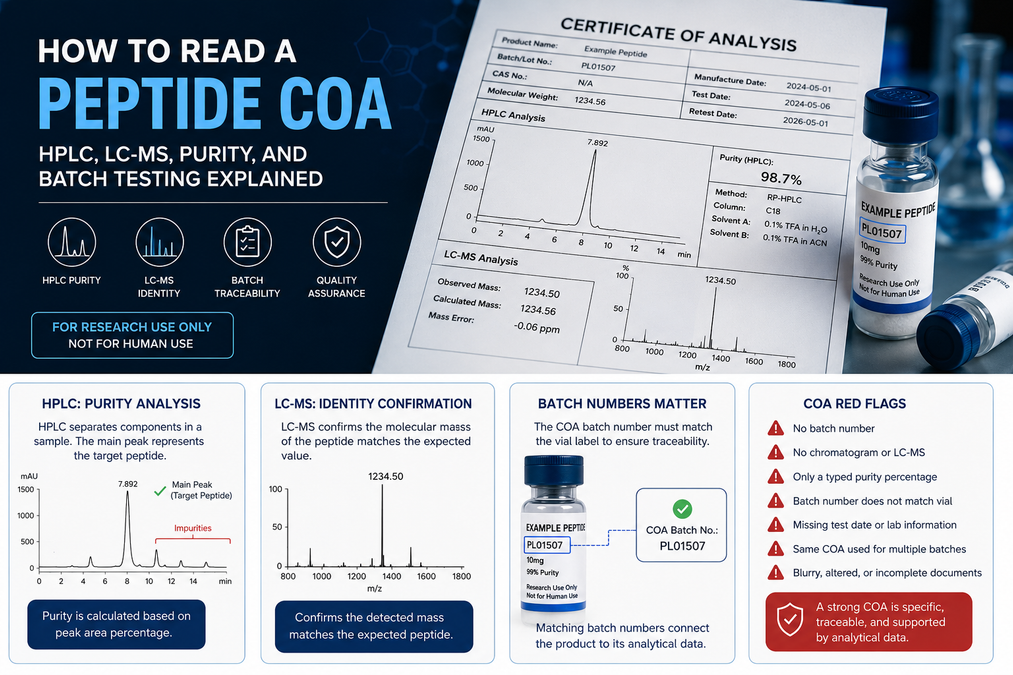
A peptide Certificate of Analysis, often called a COA, is one of the most important documents connected to a research-use-only peptide lot. It helps connect a specific batch number to analytical testing data, including identity, purity, and other quality markers.
For research settings, a COA should not be treated as a generic marketing document. It should be reviewed as a batch-specific quality record.
This article explains what researchers commonly look for when reviewing a peptide COA, including HPLC, LC-MS, purity percentages, batch numbers, and common warning signs.
What is a peptide COA?
A Certificate of Analysis is a document that summarizes analytical testing performed on a specific material or batch. For peptides, the COA usually includes information such as:
- Product name
- Batch or lot number
- Purity percentage
- Analytical method
- Molecular weight or mass confirmation
- Testing date
- Manufacturing date
- Expiration or retest date
- Laboratory or analyst information
- Supporting data such as chromatograms or spectra
The key point is that the COA should match the exact batch or lot being reviewed. A COA that does not list a batch number, or uses a batch number that does not match the vial label, is less useful for research documentation.
Why batch numbers matter
Batch numbers connect the physical vial to the analytical record.
For example, if a vial label lists Batch PL01507, the COA should also reference Batch PL01507. This connection matters because peptide quality can vary between lots depending on synthesis, purification, handling, storage, and testing.
When reviewing a COA, check that the batch number on the document matches the product label. If the batch number is missing, reused across unrelated products, or does not match the vial, that is a red flag.
What HPLC tells you
HPLC stands for high-performance liquid chromatography. In peptide testing, HPLC is commonly used to evaluate purity by separating components in a sample and measuring the relative signal from each detected peak.
A simplified way to understand it:
- The main peak usually represents the target peptide.
- Smaller peaks may represent impurities, byproducts, fragments, or related substances.
- The reported purity percentage is usually based on peak area, not necessarily total active content.
For example, a peptide listed as 98.7% pure by HPLC means the main detected peak represented 98.7% of the measured chromatographic area under that test method.
Why purity percentage alone is not enough
A high purity percentage is helpful, but it should not be the only thing reviewed.
A COA that only says “99% purity” without supporting data is incomplete. A stronger COA should include either the chromatogram itself or enough analytical detail to understand how the purity number was generated.
When reviewing peptide purity, look for:
- HPLC method listed
- Chromatogram included
- Main peak clearly visible
- Retention time shown
- Purity percentage reported
- Batch number listed
- Test date included
Purity should be supported by data, not just typed into a table.
What LC-MS tells you
LC-MS stands for liquid chromatography-mass spectrometry. While HPLC is commonly used to evaluate purity, LC-MS is commonly used to help confirm molecular identity.
In simple terms, LC-MS helps answer a different question:
- HPLC: How pure does the sample appear under this method?
- LC-MS: Does the detected mass match the expected peptide?
This matters because a sample can show a strong HPLC peak while still needing identity confirmation. For stronger documentation, peptide COAs should ideally include both purity testing and identity confirmation.
What to look for in a strong peptide COA
A useful peptide COA should be specific, traceable, and supported by analytical data.
Look for:
- Exact product name
- Exact batch or lot number
- Purity result
- HPLC chromatogram
- LC-MS or mass confirmation
- Molecular formula or expected molecular weight
- Testing date
- Manufacturing date
- Expiration or retest date
- Laboratory information
- Clear connection between the COA and the vial label
The stronger the traceability, the easier it is to compare results between batches and maintain organized research records.
Common COA red flags
Not every COA provides the same level of documentation. Some warning signs include:
- No batch number
- Batch number does not match the vial
- No chromatogram
- No LC-MS or identity confirmation
- Only a typed purity percentage
- Same COA reused across multiple batches
- Missing test date
- Missing lab information
- Blurry or altered-looking documents
- Product name mismatch
- Purity claims without supporting data
A COA should make the product easier to verify, not harder.
HPLC vs LC-MS: quick comparison
| Method | What it helps show | Why it matters |
|---|---|---|
| HPLC | Purity and separation profile | Helps show the main peak and related impurities |
| LC-MS | Molecular identity | Helps confirm the detected mass matches the expected peptide |
| Batch number | Traceability | Connects the vial to the specific test record |
| Chromatogram | Visual analytical support | Helps verify that the purity number is supported by data |
Why COAs support research reproducibility
In research, consistency matters. If two vials from different batches have different purity profiles, impurity profiles, or storage histories, they may not perform identically in a laboratory setting.
That is why batch-specific COAs are useful. They help researchers document what material was used, when it was tested, and what analytical profile was reported for that batch.
A COA does not replace proper laboratory controls, but it does support better recordkeeping and more transparent material review.
Final checklist before trusting a peptide COA
Before relying on a COA, review the following:
- Does the batch number match the vial?
- Is the product name correct?
- Is HPLC purity listed?
- Is a chromatogram included?
- Is LC-MS or mass confirmation included?
- Is the testing date shown?
- Is the lab or testing source identified?
- Does the document look specific to this batch?
- Are there any mismatches between the label and COA?
If the answer to several of these questions is no, the COA may not provide enough information for confident research documentation.
Summary
A peptide COA should do more than list a purity percentage. It should connect a specific batch to analytical testing data, including HPLC purity, LC-MS identity confirmation, and traceable documentation.
For research-use-only peptides, strong COA review helps support transparency, organization, and reproducibility in laboratory settings.
The most important things to check are simple:
- Match the batch number.
- Review the HPLC purity data.
- Look for LC-MS identity confirmation.
- Confirm the COA is batch-specific.
- Watch for missing or generic documentation.
Standards and further reading
Prepared by The Pep Labs Research Editorial Team under the editorial policy.